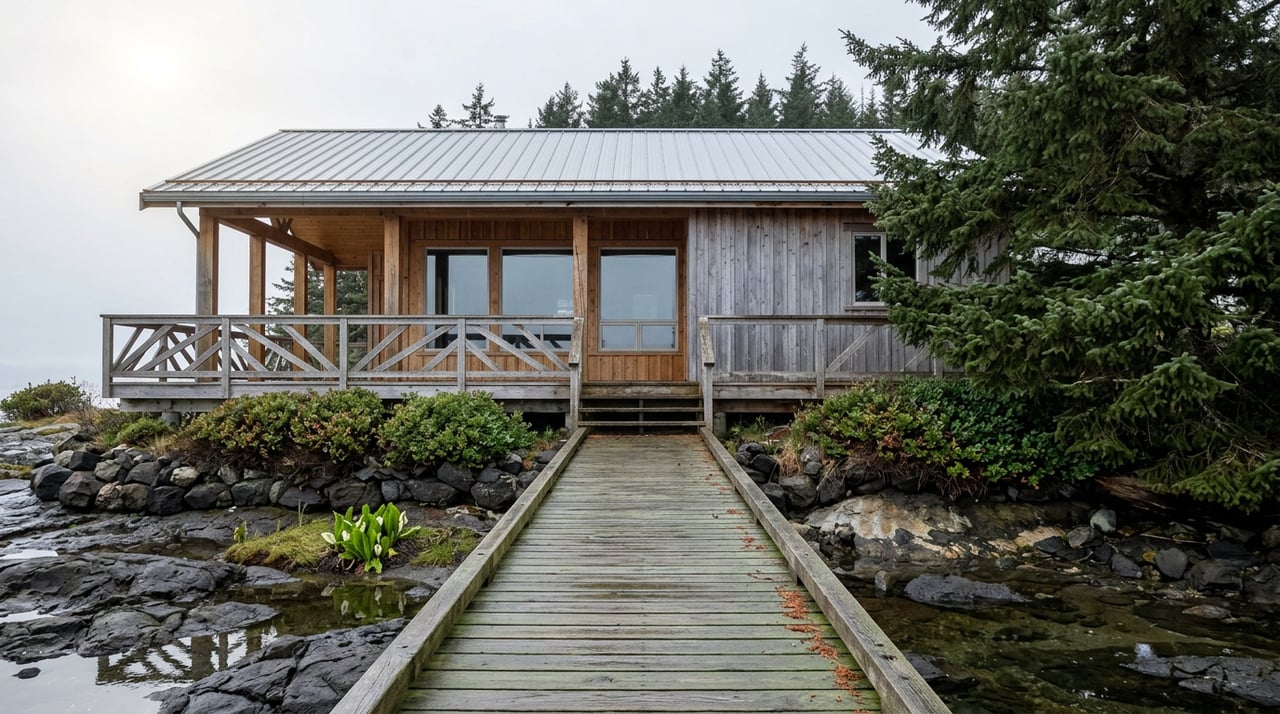
Sitka Doesn't Have a Supply Chain. It Has a Sailing Schedule.
September 24, 2026
September 24, 2026
A buyer under contract on a Sitka renovation last year picked out windows in April, expecting installation by June. Her contractor gave her the real timeline: the windows had to be on a truck to Seattle by a specific Tuesday, or they'd miss that week's barge, and the next sailing wasn't for seven days. Miss two sailings in a row because of a backordered frame size, and a June install slides into August. Nobody in the transaction was slow. The barge simply doesn't wait, and there's no other way to get a window to Baranof Island.
That's the piece of Sitka's real estate math that doesn't show up on a spec sheet or a listing description. If you're comparing Sitka to other Southeast Alaska towns while planning a build, a remodel, or a lodge purchase, the number that actually moves your budget isn't the price per square foot you find on a national cost calculator. It's the sailing schedule.
Sitka sits on Baranof Island with no road connection to anywhere. Not to Juneau, not to the rest of Southeast Alaska, not to the Lower 48. Every board, window, fixture, and bag of concrete mix arrives one of two ways: barge or air freight, and for anything heavy or bulky, that means barge.
Two carriers run that route on a fixed clock. Alaska Marine Lines sails twice a week to Southeast Alaska, calling on Sitka along with Juneau, Ketchikan, Petersburg, Haines, Skagway, and Wrangell. Samson Tug & Barge, an Alaska family-owned company that's been hauling freight to Sitka since 1937 and is headquartered right in town, runs a weekly sailing from Seattle. Between those two schedules, that's the entire menu. If your materials miss a cutoff, you're not waiting for a truck to reroute. You're waiting for the next boat.
This is the part that catches people off guard when they're used to mainland construction, where a supplier delay means a same-week fix. In Sitka, a supplier delay means the next sailing, and the next sailing is measured in days, not hours.
Not every Southeast Alaska community is boxed in the same way. Haines and Skagway sit at the northern end of the same Inside Passage ferry network that serves Sitka, but both towns have highway connections that run north through Canada and tie back into the rest of the continental road system. A truck can drive materials into Haines or Skagway. Nothing drives into Sitka.
That difference doesn't show up in a median home price, but it shows up in how a renovation actually unfolds. A contractor in Haines can call a supplier in Seattle and get a delivery date measured against highway traffic and border crossing times. A contractor in Sitka is checking a sailing calendar first, then working backward from whichever week the barge leaves with room for a 40-foot container.
| How materials arrive | What sets your timeline | |
|---|---|---|
| Sitka | Barge only (Alaska Marine Lines, Samson Tug & Barge) or air freight | Weekly and twice-weekly sailing cutoffs |
| Haines / Skagway | Truck via Canada, or barge | Highway conditions and border crossing times |
| Anchorage / Mat-Su | Truck via the state road system | Contractor scheduling and standard supplier lead times |
If you've priced a build against Anchorage numbers and assumed Sitka would run similarly, this is the gap. It's not that Sitka contractors are slower. It's that the whole town is working against a boat that leaves whether your order is ready or not.
Statewide, Alaska construction runs $250 to $500 per square foot in 2026, well above the Lower 48 baseline, mostly because everything still has to arrive by barge or plane rather than truck. Remote and Southeast Alaska builds push past that, into the $400 to $700-plus range, and a big piece of that gap traces directly back to freight. Shipping a standard container from Seattle adds roughly $5,000 to $8,000 to material costs versus an equivalent Lower 48 delivery, and a typical home build eats five to eight container loads. That premium compounds fast, and it's before labor or the short building season even enter the math.
Timelines stretch the same way. A build that might run 12 to 18 months in Anchorage or the Mat-Su Valley often runs 18 to 24 months for remote or Southeast Alaska projects, because every missed sailing or backordered item pushes the whole schedule out by however long it takes the next boat to arrive.
None of this is a knock on Sitka contractors, who are working around a genuinely fixed constraint rather than a preference. It's the reason a renovation budget built on a national average, or even an Anchorage average, will come up short if you don't build in the freight math from the start.
Here's the part of the story most buyers researching Sitka never hear about, and it's the one thing quietly working against that fixed geography, at least at the margins.
The Katlian Bay Road is a state-funded project on Baranof Island, roughly nine miles of new single-lane, unpaved road running from the north end of Halibut Point Road east along Katlian Bay to the boundary of Shee Atika and U.S. Forest Service lands. The contract went to K&E Alaska Inc., a Sitka-based company, and the project traces back to a 2012 bond package that Sitka voters and the state approved. Construction was expected to run two to three years once the contract was awarded.
The road matters for one specific reason that has nothing to do with connecting Sitka to the outside world, because it doesn't. It never will. What it does is open access to material sources on state, federal, and Native corporation lands that the island currently doesn't have road access to. Sitka has a documented shortage of developable material sources, gravel and fill among them, and right now anything the town can't quarry locally still has to come in by barge.
What the Katlian Bay Road changes, if it delivers on that goal, is Sitka's ability to source some of its own construction materials on-island instead of shipping every load of aggregate in from outside. What it doesn't change is the barge schedule for lumber, windows, fixtures, or anything else that has to come from Seattle. It's a narrow crack in a mostly fixed constraint, not a fix for the whole problem.
If you're evaluating land near the Katlian Bay corridor or thinking about how local material availability might shift over the next few years, this project is worth watching. It won't turn Sitka into a road-connected town. It might, over time, take some pressure off one specific line item in a building budget.
If you're weighing Sitka against Haines, Skagway, or a road-connected market in Southcentral Alaska, the freight schedule is the variable to build your budget around, not an afterthought to add later. A few things worth carrying into that comparison:
This is exactly the kind of detail that gets lost in a national build-cost calculator and exactly the kind of thing that matters once you're actually under contract. If you're looking at property in Sitka from a distance, whether it's a waterfront lot, a lodge, or a home that needs work, the team at Beloved Alaska Realty walks Sitka's freight realities, its material sourcing, and its sailing schedules with buyers regularly, and can help you build a realistic timeline before you're locked into one.
Does the Katlian Bay Road mean building materials will get cheaper in Sitka? Not directly. The road is designed to open access to local material sources like gravel and fill on Baranof Island, which could ease sourcing for some site work and aggregate. It doesn't create a road connection off the island, so lumber, windows, and finish materials will still arrive by barge on the same Alaska Marine Lines and Samson Tug & Barge schedules.
Why do Haines and Skagway cost less to build in than Sitka? Both towns have highway connections through Canada, which means materials can arrive by truck rather than barge exclusively. Sitka has no road link anywhere, so every heavy or bulky material has to come in on a fixed sailing schedule, which adds cost and time that road-connected Southeast Alaska towns don't carry to the same degree.
How far in advance should I plan material orders for a Sitka build? Given weekly and twice-weekly sailing cutoffs, and the fact that a missed sailing can push a delivery back a full week or more, it's worth ordering with more buffer than you would on the road system, particularly for custom items like windows or cabinetry that can't be swapped for whatever's on the next boat.

I know that hard work, knowledge and dedication are required to earn my client's business, respect, and most importantly their trust. I would be honored to work with you in any real estate dealings