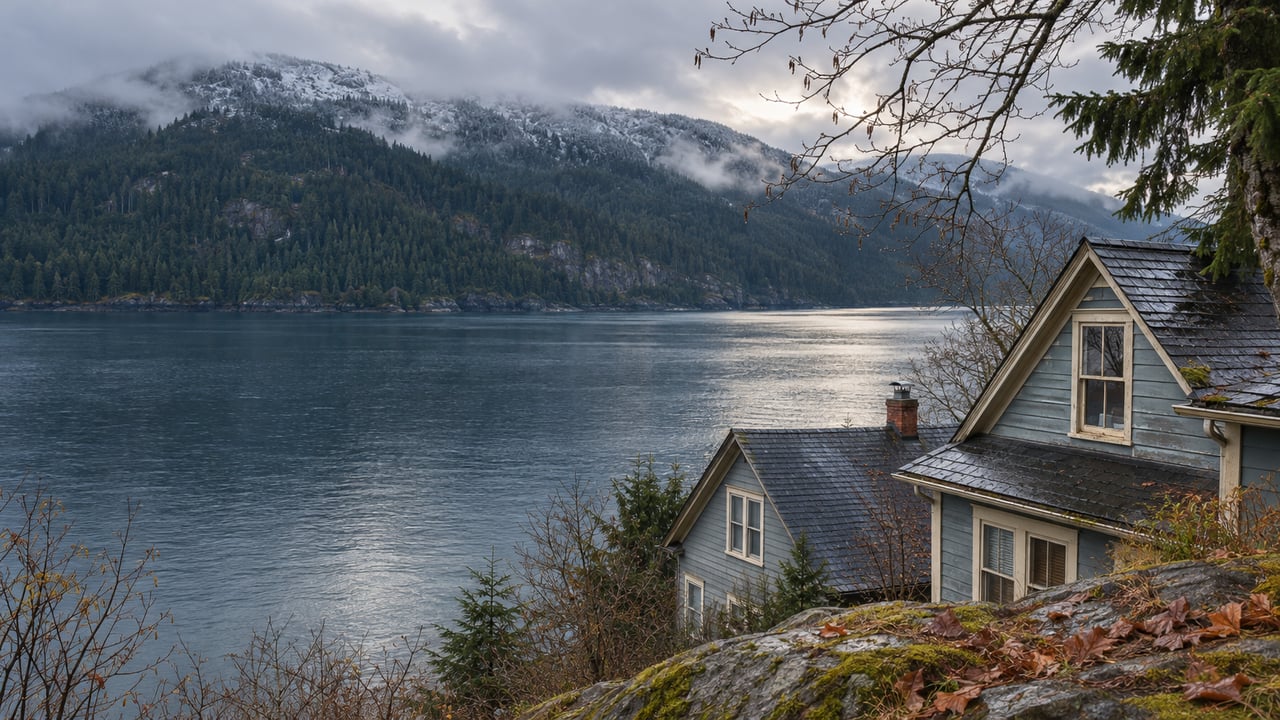
Juneau's Telephone Hill Has Had Three Names, and Its Next Chapter Starts This Winter
Suzanne Jasso November 19, 2026
Suzanne Jasso November 19, 2026
The oldest house on Telephone Hill stands at 135 W. Second Street. Edward Webster built it in 1882. Eleven years later he and Frank Bach founded the Juneau and Douglas Telephone Company, and they ran it out of an addition to his home. The company stayed in the Webster House from 1915 to 1958. The city's historic survey calls it the first commercial telephone service in Alaska. Today a fence runs around that house and its six neighbors. The City and Borough of Juneau put it up in October 2026 to secure the properties until the next stage of site work begins.
Demolition waits on a developer the city has not yet selected, and the Assembly's review of developer responses is set for Feb. 1, 2027. Each of the hill's names has recorded what Juneau used the ground for, and that February date is when the city weighs the next use.
Before Juneau was settled, the hill was a low bedrock rise at the edge of the Dzantik'i Héeni, the Gold Creek delta. The original Áak'w Village sat at its base. According to the site and structures survey the city commissioned, the hill was called Dzantik'i, meaning "flounder," for its shape.
In 1881 the U.S. Navy set up a government reservation and military post on the northern part of the hill. Courthouses followed. The first went up in 1893, and after a fire in 1898 a second was built in 1904. That gave the hill its first settler name, Courthouse Hill. The 1904 courthouse was later torn down for what is now the State Office Building.
The second name came from a business. The survey credits the telephone company's role in the neighborhood's growth for the new name. It applied to the part of the hill south of Third Street, which is where the houses stand. That is why the State Office Building and the residential blocks below it can share one ridge and still read as two places on a walk up from Main Street.
The survey lists seven houses on the hill, with their historic names and dates:
The names go back to Juneau's first years. The survey identifies Richard Harris, a co-founder of the Juneau Townsite, as an early homeowner whose family kept property on the hill until the 1950s. It also names John G. Peterson, who staked mining claims in the Eagle River District during the first gold rush and built a home here.
In a February 2026 opinion piece in the Juneau Independent, Dorene Lorenz wrote that Dick Harris and his wife, Kate "Kitty" Newcombe Harris, a Tlingit woman from Hoonah, bought Lots 1 and 2 in March 1881. She also wrote that the attorneys Edward Bayless and Louis Shackleford kept a law library on the hill. Her piece reads the hill as a mixed neighborhood that grew up around the Harris home. It treats the residential blocks south of Third Street as separate from the 1881 government reservation on the summit.
The survey was meant to support future formal determinations of eligibility for the individual houses and for the neighborhood as a district. It did not make those determinations itself.
The hill's current name has held for more than a century. Its use has been in question since 1984, when the State of Alaska acquired the land to build a new legislative complex. That complex was never built. In 2022 the state transferred the land to the City and Borough of Juneau to pursue economic redevelopment. The same year, Juneau voters approved $2 million for the redevelopment as part of the 1% sales tax proposition.
The city's interest comes down to geography. A buildable-lands study the city completed in 2006 looked at 14 potential sites and found none in downtown Juneau. Telephone Hill was not city property then. Now it is the largest city-owned parcel downtown that can be redeveloped, it already has the right zoning, and it has basic utilities and direct road access. On May 5, 2025, the Assembly approved $5.5 million for demolition and site preparation. It also approved distributing eviction notices to tenants of the hill's 13 rental units. The move-out date was later set at Nov. 1, 2025, according to the Juneau Independent.
Of that $5.5 million, $2 million came from the voter-approved sales tax and $1 million from the general fund. The rest came from the Lands Special Revenue fund, which is built from the sale and development of city land.
The redevelopment has drawn organized opposition. In 2025 a group called Friends of Telephone Hill circulated a petition titled "Stop the Bulldozers on Telephone Hill," as the Juneau Independent reported.
Bid-ready plans for demolishing the houses were finished in October 2026. They are on hold because of a decision the Assembly made at its April 13, 2026 Committee of the Whole: staff were told not to award demolition bids until a site-specific development plan was in hand. That plan will come from a developer chosen through a Request for Qualifications, and demolition follows the review and selection of RFQ responses.
The RFQ is now drafted. The Assembly reviewed next steps at a Committee of the Whole worksession in early November, and the Juneau Empire reported on that meeting. City Manager Katie Koester called the RFQ the result of three years of public process. "The Assembly has done their best to lay out a vision that's consistent with community values and public process," she said. "However, we understand that there are many factors that influence feasibility and a developer's ability to bring the project to fruition."
Carole Bookless, an architect who lives in Douglas, sent the Assembly a letter about the draft. As the Empire reported, she wanted the document to weigh local experience and design for Southeast Alaska conditions. "Building on a flat site in the middle of an urban or rural prairie in the Lower 48 does not equate to building on Telephone Hill," she said.
The calendar is now set. Koester said RFQ responses will be evaluated from Jan. 4 to 15, 2027, and the Assembly will review the responses and results on Feb. 1, 2027. Those two dates fall before demolition can begin.
The draft calls for up to 155 housing units, along with open space and recreation areas. The city's plan puts four buildings on 1.4 acres. The units would be studios, one-bedrooms and two-bedrooms, and 31 of them would be subsidized by the city for households at 80% of area median income. The whole study area is about 4.2 acres. It includes the Downtown Transit Center, surface and structured parking, a public park and a road. The city's FAQ links the project to a wider housing need. That need includes about 200 Coast Guard servicemembers and their families moving to Juneau with the new icebreaker.
Most of what makes the hill a daily route will stay. The Telephone Hill park, the switchback trail and the parking garage are not part of the redevelopment. The steep grade makes the hill a natural barrier between the Downtown and Áak'w Kwaan Village districts. Today people cross it on W. 3rd Street by car or take the elevators in the DTC Parking Garage and the State Office Building on foot. The Second Street Tunnel between Main Street and Willoughby Avenue runs 12 to 15 feet below the top of the hill. The building parcels sit on either side of it with a 30-foot easement between them, and no new building is planned directly over the tunnel.
The trees are the biggest visible change. The city says a tree canopy will be reestablished around the hill after construction. Residents raised green space when the Juneau-Douglas City Museum ran a telephone history exhibit in 2024. "The green is critical," Katie Henry told KTOO. "It's part of what makes it still feel OK to be downtown." That exhibit also showed photos of the neighborhood taken about 50 years apart. Former hill resident Skip Gray took two of them, in 1973 and 2022.
You can see the proposed layout in the city's Telephone Hill Place Guide, and the project page carries the latest updates. Until the Feb. 1 review, the seven houses are still standing on Dixon, Second and Third streets behind the fence.
Downtown Juneau's oldest blocks show how much of Southeast Alaska's history is held in a few specific houses. At Beloved Alaska Realty, a Sitka-based brokerage working across Southeast Alaska, we think a home's story belongs in how it is presented. If you own an older Southeast home with a history like the ones on Telephone Hill, request a virtual tour or local consultation and we'll talk through how to show it with care and context.

I know that hard work, knowledge and dedication are required to earn my client's business, respect, and most importantly their trust. I would be honored to work with you in any real estate dealings